| Info 13b, alexander gunn | Close info Window |
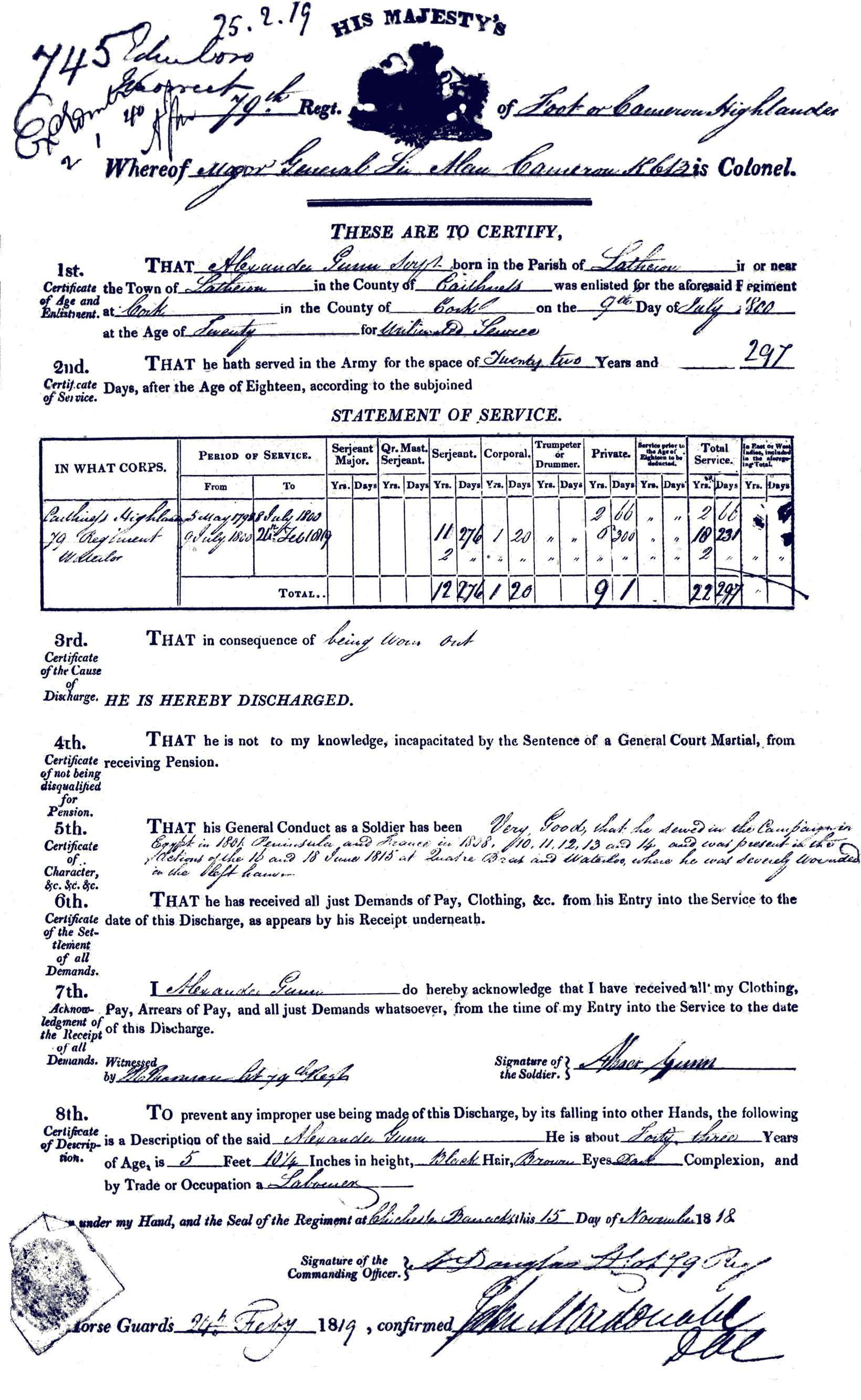
On 5th May 1798 Alexander Gunn joined the local fencible regiment the Cathness highlanders
in 1800 proptem nodoubt by the enlistment bounty of £15 he enlisted in the regular army
with the 79th regeiment of Foot also know as the Cameroon Highlanders.
Possible amy service
Regimental Register  79th Foot 1st Battalion
Attestation 9th July 1800

Alexander Low
height 5ft 11 inches
Age 26 years 28 days
Complexion; dark, Visarge ;long,
Eyes; Brown, Hair; Black,
Born Lathern, Caithness
Occupation; LABOURER
former militery; Caithness Highlanders
from; ~~~ till:  8th July 1800
(Formerly known as the Rothesay and Caithness Fencibles)
During the wars facing Great Britain towards the end of the 18th century a number of Fencible Corps were raised for home service in order to free the regular army for duty overseas. In addition to eight regular army Highland regiments, over forty fencible regiments were raised in Scotland in 1793/4.
Among these was the Rothesay and Caithness Fencibles, raised by Sir John Sinclair on a letter of service dated 7 March 1794.
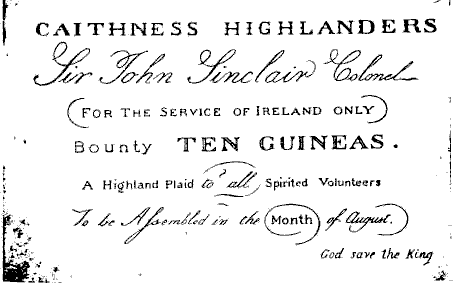
By 1794 the number of volunteer regiments being raised was so great that it was becoming difficult to recruit sufficient men. Competition between officers for suitable recruits saw the bounties paid on enlistment rising sharply and these were eventually set at a maximum of 10 guineas for fencibles and 15 guineas for regular army recruits.
As, at that stage, privates in the fencibles regiments were paid only 6d per day, this represented more than 1 year pay!
Despite recruitment difficulties, Sir John Sinclair was able to raise a regiment 600 strong, with the bulk of the officers and men coming from Caithness, with others from the adjoining county of Sutherland. The regiment was paraded in Inverness in October 1794 and officially recognised as the "Rothesay and Caithness Fencibles" (ie incorporating the Scottish title of the Prince of Wales).
Recruiting card, 1799
As soon as the regiment had been officially embodied, Sir John Sinclair offered to raise a second battalion, whose services would extend to Ireland. Letters of service were issued in December 1794. However by then recruitment of volunteers was more difficult and the maximum permitted bounty had to be paid and men recruited from further afield. By May 1795 the second battalion, 600 strong, was paraded and declared an effective corps. The battalion was then marched to Ayrshire and from there crossed to Ireland.
At this time the majority of the officers and men volunteered to extend their service to any part of Europe. This resulted in their rate of pay being increased from 6d to 1s per day (ie the same as for the regular army) and entitled them to a pension in the event of their being disabled
In 1799 the British Government decided to disband all fencibles whose services were limited to Great Britain and as a consequence the first battalion, then stationed in the north of England, was marched to Edinburgh and disbanded on the 6 May. Just prior to this, Sir John Sinclair was authorised to raise the strength of the second battalion from 600 to 1000 men, which then officially became known as the "Caithness Highlanders". Over half the strength of the first battalion volunteered for service in this renamed unit.
In June 1800 the Government began encouraging fencibles to volunteer into the regular army. Four officers and 220 men from the Caithness Highlanders took this step and joined the 79th and 92nd Highlander regiments. Alexander Gunn enlisted in the 79th Regiment of Foot (also known as the Cameron Highlanders) on the 9th July 1800.

 |
|
Back to TOP © JCC Glass Updated 7th September 2022 |

|